
‘I’ll scare you, then make you laugh while offering you tea and a biscuit’
The horror writer and film journalist talks about being raised by VHS, finding humour in darkness, writing the characters he once searched for and giving a talking cat the best lines
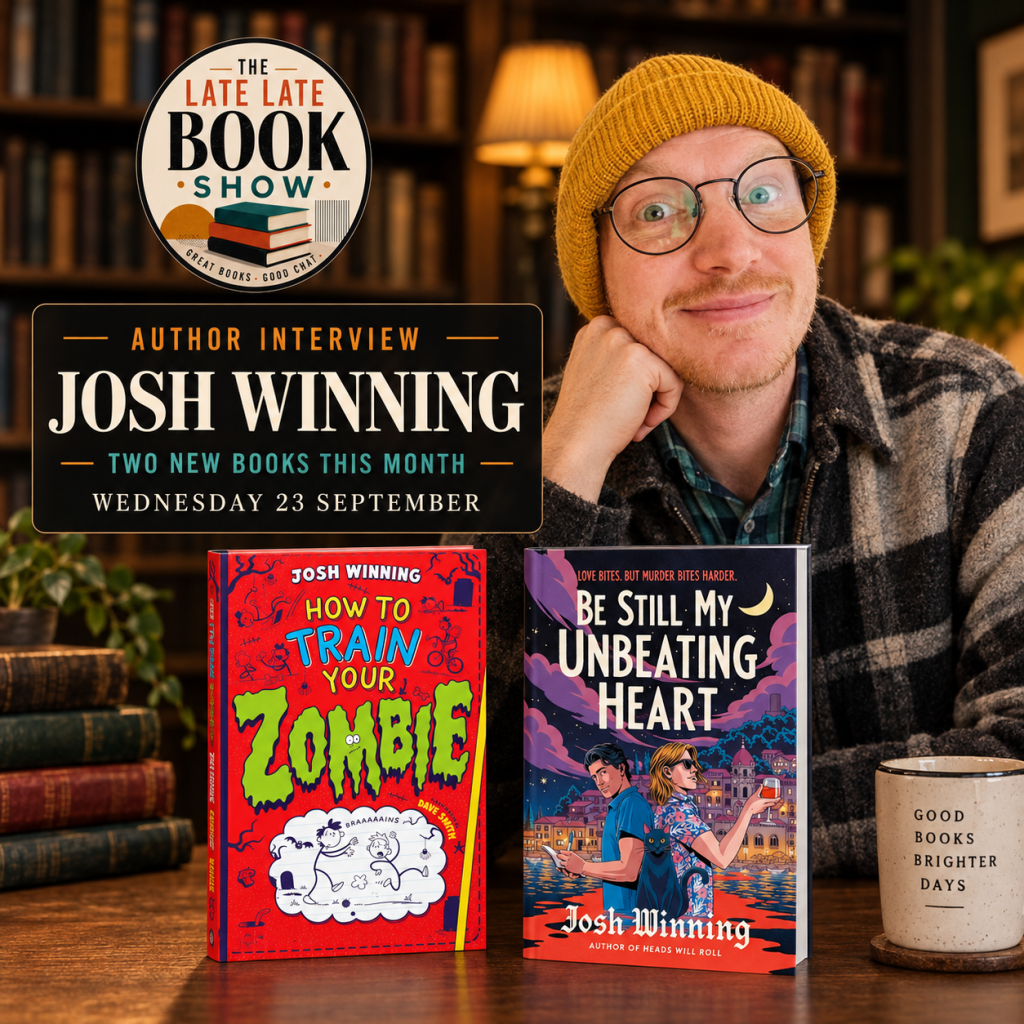
I met Josh Winning on a video interview call, he is sitting in front of the kind of bookcase he says he dreamed of owning as a child. Packed with horror novels and memorabilia, it is a fitting backdrop for a writer who describes himself as a “video-store kid” raised on VHS.
“I grew up consuming movies, television shows and books,” he says. “Pop culture has always been my filter for the world. It’s how I understand the world and, frankly, it was my education.”
That education is evident in Winning’s exuberantly varied fiction. His novels have included supernatural slashers, cursed film productions and a queer vampire mystery, while his first book for younger readers, How to Train Your Zombie, adds an undead child to the mix. The subjects may change, but each story combines an affection for genre with humour, emotional warmth and a fascination with outsiders.
Beneath the playful surfaces lies a more personal preoccupation. Winning lost his mother to cancer shortly after turning 21, an experience that continues to make its way into his fiction.
“Whenever I start a new book, I think: ‘Right, this one isn’t going to be about grief,’” he says. “Then inevitably it becomes about grief. That’s probably why there’s this strange mix of humour and hope, but also darkness and weirdness. Grief and pop culture are the two things most prevalent in my life.”
Winning began his career as a film journalist, although writing fiction had been a constant presence since childhood. As a teenager, he devoured horror and fantasy magazines, followed writers’ bylines and created websites devoted to films including I Know What You Did Last Summer and Urban Legend. Journalism, he believes, gave him the tools to become a novelist.
“I genuinely don’t think I would be a published author if I hadn’t been a film journalist first,” he says. “It taught me the importance of the pitch and that every word has to earn its place on the page.”
It also shaped the visual quality of his prose. Winning writes by following the film playing in his imagination. If he cannot picture the opening image, location or first movement of a scene, he finds it almost impossible to continue.
“I totally write the movie that’s playing in my head,” he says. “Sometimes I have to stop that movie and cut scenes out of it, but if I can’t see a scene, I can’t write it.”
He is a meticulous planner, driven partly by a fear of the blank page. Before beginning a draft, he needs to understand what each scene contributes and why it deserves to exist. He may outline an entire novel chapter by chapter or plan only its first half before pausing to reassess.
“There’s no point carrying on if you reach the midpoint and know there’s a huge amount you need to change,” he says. “It’s disheartening to finish a draft knowing how much you’re going to have to rewrite.”
This pragmatism has required Winning to make peace with what once seemed like waste. Scenes, characters and subplots are frequently removed after he has brought them to life on the page. Some find new homes: a death scene discarded from one manuscript later appeared in Burn the Negative.
“The mess left over at the end is part of what’s necessary when you’re making art,” he says. “An idea is never dead. It may just be trying to find the right place.”
For all the darkness in his work, Winning is instinctively drawn to comedy. He describes himself as someone who will “scare you and then make you laugh while offering you a cup of tea and a biscuit”. The apparent calm, however, may be deceptive.
“I’m always surprised when people say I seem serene,” he says. “I compare myself to a goose rather than a swan. On the surface I’m calm; underneath, I’m kicking away like mad.”
That combination of anxiety and composure is reflected in his characters, many of whom confront frightening situations with a quick joke and an unexpectedly light touch. Winning tries to make his novels as funny as possible without allowing humour to weaken their emotional stakes. Trusted early readers help him judge where a joke is needed – and where one should be removed.
His affection for rapid-fire dialogue owes much to the American sitcoms he watched in the 1990s: Friends, Frasier, Caroline in the City and Spin City. Their influence can be heard in the bickering between Bastian, the vampire at the centre of Be Still My Unbeating Heart, and Whitby, his talking feline familiar.
The cat came first.
“I only wrote the book because I wanted to write this snippy talking cat,” Winning says. “The interplay between them was the easiest part. It was just there – that magical thing that almost never happens when you’re writing.”
The novel sends Bastian and Whitby on holiday to Vernazza, on the Ligurian coast, where they discover a body on the beach with its throat torn out. Suspicion naturally falls upon the visiting vampire, forcing him to investigate the murder with an attractive Italian police officer.
Winning had never visited Italy when he wrote the book. He researched Vernazza through maps and videos, then finally travelled there on his honeymoon after completing the manuscript.
“I was terrified that I’d got it completely wrong,” he says. “Walking through the streets was surreal because I already had such a strong sense of the location. What surprised me was how labyrinthine it is, with these beautiful narrow alleyways twisting up and around the town.”
Another surprise was its size. Vernazza proved much smaller than he had imagined, making the novel’s body count seem rather conspicuous.
“I walked around thinking it would be very difficult to murder that many people here and not get caught immediately,” he says. “But it’s fiction. Artistic licence.”
The vampire presented a different creative challenge. Faced with a mythology already explored by Bram Stoker, Anne Rice, The Lost Boys, Buffy the Vampire Slayer and Twilight, Winning wondered what he could add. The answer was to concentrate on the monster’s emotional life.
Bastian has spent years accepting the part of himself that others once taught him to fear. Rather than seeking a cure, he gradually learns that what appears monstrous is inseparable from who he is.
“He’s someone who has been through a lot of therapy,” Winning says. “He has this openness, calmness and dark sense of humour that makes him great company. Nothing is off limits. You can put everything on the table, pick it over and have fun.”
Winning has also spent plenty of time in therapy, he admits. Like Bastian, he is interested in recovery not as a miraculous transformation but as an unfinished process. The character has reached “near acceptance”: far enough to recognise that he is not broken, while still having work to do.
“I hope there’s comfort in the idea that the part of yourself you’ve been afraid of, or that you beat yourself up about, isn’t bad,” he says. “It isn’t a problem that needs fixing. It’s one of the many parts that make up the beautiful, unique whole.”
Just as important is Bastian’s friendship with Whitby. Their bond may generate the book’s sharpest jokes, but it also provides its emotional centre. Winning wanted to celebrate the sustaining power of a relationship that is intimate without being romantic.
“True friendship is being there for somebody and seeing them at their absolute worst – or simply when they’re not doing particularly well – and still loving, accepting and supporting them,” he says. “The book is about finding your home and your place. That can be a physical location, but it can also be a person.”
Winning’s outsider characters have deep roots in his own childhood in a small Suffolk town. Growing up without seeing people like himself in the stories he loved created an enduring sense of absence. Even now, he notices himself watching films and television programmes in the hope that one of the characters will turn out to be queer.
“You’re always searching for yourself in the media you love,” he says. “When you never see anybody like you, it can make you believe that there’s something fundamentally wrong with you.”
That experience led him to populate his books with the characters he once looked for. Their identities matter, but Winning does not want them to exist solely as sources of pain. They are allowed to fall in love, solve mysteries, fight monsters and occasionally become monsters themselves.
“I particularly seek out stories of queer joy, acceptance and normality,” he says. “Characters can be queer without that being the entire focus. I hope that simply by existing, they give readers a little drop of hope that they matter, that they’re seen and that they’re important.”
His earliest heroes were not men but formidable women: action heroines, horror’s resourceful final girls and, above all, Sigourney Weaver. Winning jokes that every manuscript must contain a part for her, even if she is unlikely ever to play it.
“I panic if I haven’t got a character in the book who is Sigourney Weaver,” he says. “I think: ‘God, I’ve done something wrong.’”
He is particularly fond of what he calls the “steely matriarch”: a woman who combines toughness with warmth and whose strength may initially be underestimated. His dream Weaver vehicle would cast her as an older guardian in an atmospheric horror film, protecting a group of young people while being forced to confront something buried in her past.
“She’s so good at playing people who are steely but also deeply caring,” he says. “Obviously, she would have a rifle.”
Winning recently married his partner of almost 10 years in a small town-hall ceremony followed by a meal and an afternoon at home with family, cake and conversation. Having never considered himself particularly romantic, he now wonders whether that assessment needs revising.
“Maybe I’m a quiet romantic rather than a big, splashy-wedding romantic,” he says. “I think I’m freer in my writing than I am in everyday life. It’s easier to write other people smooching.”
His professional life remains less settled. Despite an established career, Winning says publication never feels guaranteed. One young-adult manuscript he loves has yet to find an English-language home, while his next adult novel is beginning its search for a publisher.
“To the outside world, people might say: ‘You’ve made it,’ but that isn’t true,” he says. “It’s never a given that a book will be picked up. You always hope it finds a home.”
For now, he is writing the second How to Train Your Zombie adventure and continuing to work within the territory he has made his own: cinematic horror with humour, tenderness and a generous supply of pop-cultural affection.
“The genre,” he says with a smile, “is me.”
Be Still My Unbeating Heart and How to Train Your Zombie are released in September and will be available at all good book shops and through the usual on line retailers.
Leave a Reply