
‘I wanted to show gay life, warts and all’: Joe Brewer-Lennon on Andy Angus, chosen families and finding hope in dark times
By Jonathan Welford
The Scottish nurse and independent author talks about creating his accident-prone diarist, recording overlooked queer histories and Andy Angus is the grown up gay Adrian Mole
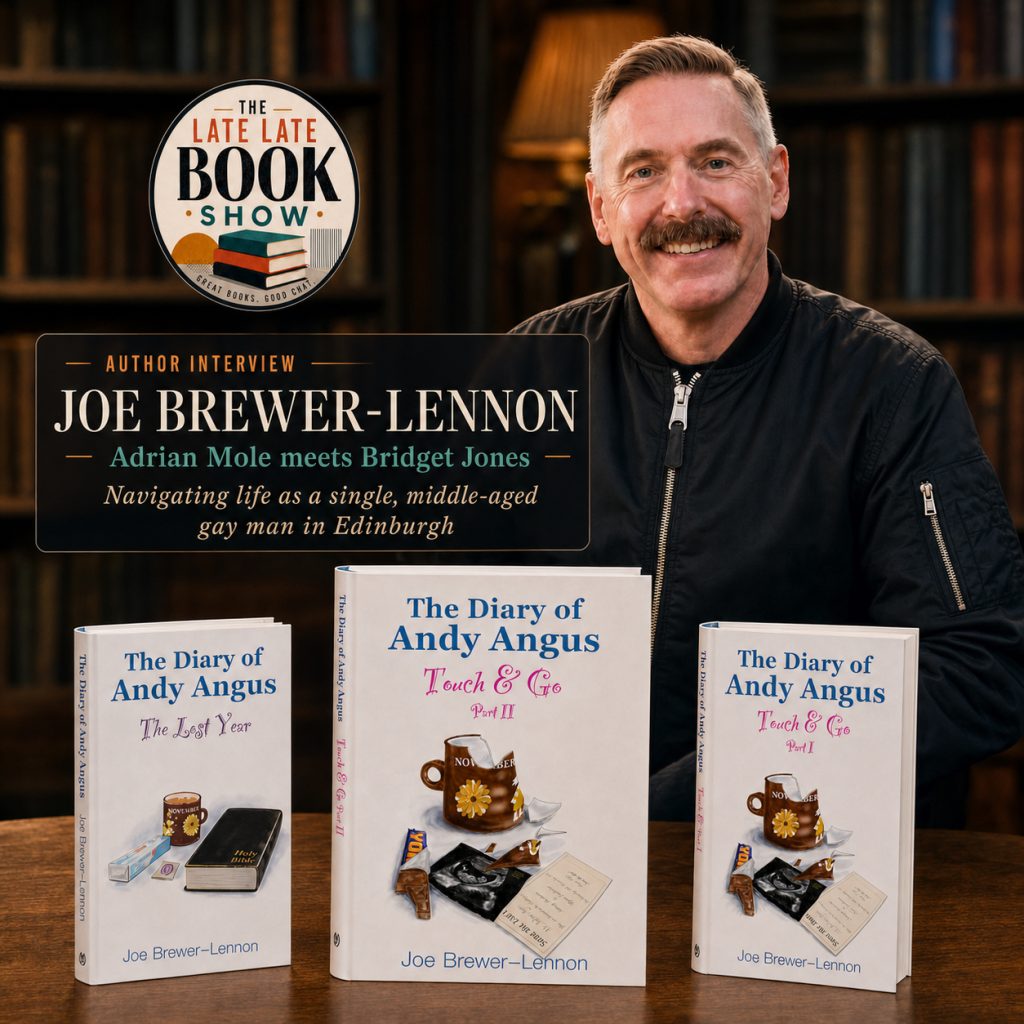
Joe Brewer-Lennon’s latest novel is not a book to be slipped casually into a coat pocket. At around 200,000 words, The Diary of Andy Angus: Touch & Go — Part Two is an epic continuation of the life of a gay Scotsman whose talent for overthinking is matched only by his ability to stumble into romantic, sexual and social calamity.
Brewer-Lennon describes the preceding volume as the starter and the new novel as the “big main course”. It is an apt comparison. His books are generous, crowded affairs, filled with friendships, family disputes, old lovers, new suspicions and enough comic disasters to sustain a particularly eventful soap opera.
At their centre is Andy Angus, a thirtysomething gay man forced to rebuild his life after a decade of domestic seclusion in the Scottish Borders.
When readers first encounter him in The Diary of Andy Angus: The Lost Year, Andy is preparing to propose to Thomas, his partner of 10 years. He imagines himself as a domestic god and plans an elaborate family celebration. Instead, his aunt dies and he discovers that Thomas has been dogging in local lay-bys.
His carefully arranged existence collapses. Andy returns temporarily to his childhood bedroom before an invitation from his estranged friend Ryan draws him back to Edinburgh. There, single for the first time in a decade, he must negotiate a city, a gay scene and a way of dating that have all changed while he was away.
“He’s learning to start again,” Brewer-Lennon says. “I wanted to tell the story of a single gay man and what it felt like to be in that environment.”
From an abandoned television series to Andy’s diary
Andy began life not in a novel but in an unmade television comedy. Years ago, Brewer-Lennon and his friend Kirsten developed a series called The Love Generation, inspired by the combination of Queer as Folk and the surreal Channel 4 sitcom Spaced.
Their writing sessions involved plenty of talking, drinking and inventive scenarios, although rather less actual writing. Eventually they assembled a script and series outline, which they optimistically sent to production companies.
“We naïvely thought they were going to love it and commission a series from brand-new writers,” he says. Unsurprisingly, television executives were not quite so obliging.
Years later, while living alone in Galashiels and having completed further study in sexual health, Brewer-Lennon found himself with free afternoons and evenings. He returned to one character from that unsuccessful script.
“I’ve always wanted to be a creative person,” he says. “I thought: this guy, Andy Angus, I wonder if I could turn him into a book?”
The character soon outgrew his television origins. Brewer-Lennon moved Andy to the Borders, placed him in a long and increasingly isolated relationship, then sent him back to Edinburgh to live among the shifting population of a bed sit style house share. Some residents pass through; others become indispensable.
Across the series, Andy reconnects with his biological family while assembling another kind of family around himself. Armistead Maupin famously calls this a “logical family”: the people we choose, as distinct from the biological family into which we are born.
That idea runs through Brewer-Lennon’s novels. Andy’s search for a partner may drive many of his decisions, sensible or otherwise, but friendship provides the more durable love story. His new community is populated by flawed, flamboyant and occasionally exasperating characters who argue, interfere and rally around one another when it matters.
A gay Adrian Mole
The diary form places Brewer-Lennon within a recognisable comic tradition. Readers have compared the books to Bridget Jones’s Diary, Christopher Isherwood’s observer-narrator and Maupin’s Tales of the City. The clearest influence, however, is Sue Townsend.
Brewer-Lennon loved the Adrian Mole novels from childhood. Once he began to recognise his own sexuality, he found himself wishing Adrian were gay and feeling disappointed that Pandora was not simply a phase.
“With Andy, in a way, I made that wish happen,” he says.
Like Adrian, Andy is earnest, insecure and only partly aware of how the reader sees him. His diary gives him control of the narrative, but it also exposes every misinterpretation, fixation and moment of self-delusion. His tendency to analyse other people’s motives is frequently undermined by his failure to recognise his own.
Brewer-Lennon wanted to place such a character within an authentically Scottish queer world.
“I wanted to show life as it was in 2010,” he says. “I wanted to take you through an authentic experience as a gay man, warts and all. It can be very frank and honest, with the bare bones and the ups and downs. I also wanted to celebrate Scotland.”
Edinburgh is one of the series’ great presences, but so is the industrial landscape of Brewer-Lennon’s upbringing. The fictional settings are grounded in places and voices he knows intimately, including Airdrie, where he grew up.
“These people are very vivid in my mind,” he says. “That made the writing so much easier.”
Why 2010 matters
The date at the beginning of Andy’s diary initially appealed to Brewer-Lennon for a surprisingly simple reason: he liked the look and feel of “2010”. But it soon became apparent that he had chosen a pivotal period in recent queer history.
Civil partnerships had been introduced in the UK in 2005. Greater legal equality and public acceptance appeared to be gathering momentum, while mobile phones, social media and dating apps were transforming how people met, socialised and had sex.
Andy has been largely insulated from those developments by his relationship. When it ends, he emerges into a world that is more permissive than the one he left, but also faster, less familiar and not necessarily kinder.
“The world had changed,” Brewer-Lennon says. “Apps were on the rise. The way we dated was changing. Even the way we spent time together in a room changed because the mobile phone became such a feature of going out in bars and clubs.”
The historical setting allows the series to explore a tension that has become more pronounced with time. Rights can be won, but they can also produce complacency. Public progress does not erase private prejudice, while apparent acceptance can conceal hostility waiting for an opportunity to return.
That tension moves to the foreground in Touch & Go — Part Two. Although Andy retains his comic voice, the novel enters darker territory, confronting discrimination and homophobia.
Brewer-Lennon says that change was unavoidable.
“We’re in 2011 and everything seems to be progressing in a positive way,” he says. “We’ve got rights and legal bills being passed, but there has always been an element of the world that isn’t happy about that and feels threatened by it.”
He wanted readers outside the LGBTQ+ community to understand what it means to spend decades asking permission to live openly, only to discover that hard-won freedoms can be threatened by ignorance or hatred.
“I want people who aren’t gay, bi or other members of the LGBTQ+ community to feel what that is like,” he says. “To have had to ask for permission to live your life as a fully functioning human being, and then to see those rights quietly and quickly stripped away.”
The result is a novel that still finds room for outrageous comic episodes, including a memorable encounter involving an ice-cream van and a Chesney Hawks Greatest Hits tape, but no longer allows comedy to act as permanent protection from the outside world.
“There are moments when we’ve felt in danger, when we’ve felt we shouldn’t speak up in a room or when we’ve hidden who we are just to get through a day or a shift,” he says.
He hopes the book might encourage quieter allies to intervene when casual prejudice surfaces in ordinary conversation.
“Maybe it will inspire somebody to stand up and say something,” he says. “It’s not all parties and rose-tinted glasses. It certainly isn’t, especially these days.”
Allowing other voices into the diary
The new book also broadens its attention beyond Andy. He remains the narrator, but the lives of the people around him increasingly carry equal or greater emotional weight.
Brewer-Lennon plans the books carefully. He knows where each volume begins and ends, then maps important events month by month. The diary format provides a useful framework, allowing him to incorporate contemporary news and social changes. Within that structure, however, the characters are free to disrupt his plans.
“There’s room for manoeuvre,” he says. “The characters shift things in different directions and sometimes surprise even me.”
He creates detailed histories for them, including information that may never appear in a finished novel. “There’s stuff about Gwen and Sally that people will never know, but I know it and it’s written down.”
In the latest volume, characters who previously occupied the edges of Andy’s story move closer to the centre. One is Trenton Tanner, an older gay man whose experiences connect Andy’s comparatively liberated present with the largely undocumented lives of previous generations.
Brewer-Lennon had originally conceived Trenton as a more stereotypical supporting character. A friend who read the first book surprised him by saying that Trenton was the person he most wanted to know more about.
“I thought: he’s the one gay uncle in their lives who can bring the story forward but also connect it to the community’s past,” Brewer-Lennon says.
He wanted to treat Trenton with greater depth and grace, while acknowledging how much queer history has already been lost.
“A lot of older people from the gay scene were never photographed or recorded because their lives had to be hidden,” he says. “They’re now reaching the age where some are passing away, and we will never fully understand what it was like to be there.”
Memories shared by older friends, some of whom have since died, helped inform the character. Through Trenton, the novel can look back at the AIDS crisis and years of discrimination without turning that history into an abstract lesson.
Class, money and the right to an ordinary life
Andy’s insecurity is not only romantic. He is surrounded by people with established careers, family money or dependable support systems, while his own life is much less secure.
Brewer-Lennon identifies Andy firmly as working class.
“It’s deliberately who he is, because it’s who I am,” he says. “He knows his place in that world, and there’s nothing wrong with it. He’s happy working in a café.”
Andy has little interest in climbing a professional ladder. He wants to cook well, maintain a comfortable home and be loved, although his culinary ambitions do not always end happily.
“I wanted to express that you don’t have to have a fantastic career,” Brewer-Lennon says. “You don’t have to be soaring up a ladder somewhere. A lot of people I know who have climbed those ladders and become managers aren’t entirely happy.”
That does not make Andy immune to class anxiety. Brewer-Lennon remembers periods when he was one wage packet away from being unable to pay his rent, and he wanted his protagonist to understand that fragility too.
Andy’s fear that a gay man has a short shelf life adds another dimension to his uncertainty. As he grows older, he worries that desirability is a diminishing form of currency and that finding a relationship may be his last chance at security or significance. His hunger to be loved can lead him to neglect the question of what else he might want from his life.
The books do not offer a neat answer. Instead, they allow Andy to be hopeful, vain, frightened, selfish, loyal and generous, sometimes within the same diary entry.
Writing between nursing shifts
Brewer-Lennon writes while working full time as a nurse. Finding the time and energy is one of the persistent difficulties of his independent career.
The rituals can be elaborate. Preparing to write may involve proper tea leaves, warming the pot and allowing the best part of an hour to disappear before he reaches the keyboard. Dialogue is read aloud to make sure each character sounds right, even if an open window leaves the neighbours wondering why he is conducting several sides of a conversation with himself.
Editing is harder. A writer who intends to check punctuation can quickly become absorbed in the story and begin rewriting entire scenes. With a novel of 200,000 words, that process becomes formidable.
Bereavement made finishing the new book still more difficult. Brewer-Lennon’s mother became increasingly unwell and died during its development. He expected grief, but was less prepared for the prolonged brain fog that followed.
“It wasn’t writer’s block,” he says. “It was trying to focus on finishing and editing. I would think: I need to reread this sentence a hundred times.”
The fog has now begun to lift, but he is giving himself space before returning fully to Andy. Time with his husband, Oliver, and with friends is not separate from his creativity. It replenishes it.
“I need to be around people and socialise to get ideas and listen to how people speak,” he says. “That didn’t happen for me during lockdown.”
Soon enough, he promises, he will be back “bashing the keyboard like a madman”, accompanied by a steaming mug of tea and something chocolatey.
Taking the independent route
Brewer-Lennon initially pursued agents and traditional publishers, but became frustrated by the time required to tailor each submission. Every agency seemed to want a different synopsis, layout, spacing or number of sample chapters.
“I was spending so much time and energy between shifts trying to get it tailored to what every agency wanted,” he says. “I thought: why don’t I just try to publish it myself?”
Independent publishing brought financial risks and a formidable promotional workload, but it also gave him complete control. No one could tell him that a sexually frank novel about a single Scottish gay man was too risky or insufficiently marketable.
He controls the content, covers and marketing, relying heavily on social media and word of mouth. What began with the conviction that hardly anyone would read the first book has developed into a committed readership.
The most startling early reader was his mother.
“She told me what page she was on and said, ‘You’ve lived a life.’ I was saying, ‘Mum, it’s fiction. Andy Angus has lived the life, not me.’”
Other readers send messages asking for the first page of the next book or wanting to know what happens to a favourite character. Brewer-Lennon refers affectionately to this growing collection of Andy enthusiasts and remains astonished by their loyalty.
Independent publishing, he says, means “flying solo”, but the response makes that solitude easier.
Andy Angus will return
There will be a fourth Andy Angus book. Brewer-Lennon already knows its title: The Diary of Andy Angus: Fearless.
He knows what happens on the day after Touch & Go — Part Two ends, who walks through the door and where the characters are heading. What he does not yet have is a finished manuscript or publication date.
He promises that the wait will not be another five or six years.
The balance between darkness and comedy will depend partly on the world into which the book is written. There will be difficult choices for Andy and his friends, but also “outrageously funny moments”, because that combination reflects life as Brewer-Lennon understands it.
“Life can be awful but ridiculous,” he says.
He also has ambitions beyond Andy. He has considered a prequel exploring Sally’s life before they meet, a science-fiction novel rooted in a working-class Scottish town, a story about the AIDS crisis of the 1980s and another pitch with a script at television.
“Once you start being creative and putting things on the page, it doesn’t really leave you,” he says. “I have a little blue book filled with notes and other things I’d like to do. It’s finding the time and energy between shifts. There aren’t enough hours in the day.”
For now, his hope is that readers finish an Andy Angus novel feeling they have not merely observed its hero but walked beside him through every disappointment, humiliation and moment of joy.
“I want them to have lived every second,” he says. “I want their lives to have been opened up to what it’s like to be a gay man and a member of the LGBTQ+ community in this changing world. I want them to feel satisfied, but still want more.”
Above all, however dark Andy’s world becomes, Brewer-Lennon wants hope to remain.
That may be Andy Angus’s most durable quality. His plans unravel, his cooking misfires and his mind turns every romantic uncertainty into an elaborate conspiracy. Yet he continues to believe in friendship, family and the possibility that life might work out.
The Diary of Andy Angus: Touch & Go — PartTwo is published independently on 15 September 2026 and will be available through Amazon in ebook, paperback and hardback.
Leave a Reply