


‘My head is probably niche’: Drew Gummerson on his funny, strange and tender worlds
The author of The Lodger, Seven Nights at the Flamingo Hotel and Saltburn has stopped chasing literary approval and started writing exactly what he likes. With Gregor, his chapbook inspired by Kafka, he talks about precarious work, queer fiction, ruthless editing and making his younger self proud.
Drew Gummerson does not write in a shed at the bottom of the garden. There is no armchair of the kind Roald Dahl used, no writing board balanced across his knees and no carefully sharpened row of pencils. He writes on his phone, usually in bed.
“Not so dramatic,” he says. “Usually I’m a bit hungover. I wake up, open my eyes and my brain’s ready to go.”
Entire books have been written this way, thumbed into existence beneath a duvet, one short, strange episode at a time. It feels fitting for a writer whose characters rarely enjoy grand rooms or grand prospects. They wash dishes in hotels, drift through seaside towns, get stuck in terrible jobs and make questionable decisions. They are often selfish, sometimes filthy, occasionally tender and almost always trying to get through the day.
Gummerson has developed a succinct answer for people who ask what sort of books he writes. “I write fiction, and I write funny, sad stories. They are often, but not always, gay or queer.” It is a neat description of work that resists easy categories: fast, conversational tales in which everyday disappointment can tip abruptly into absurdity.
His first book, The Lodger, published in 2002, is the closest he has come to a conventional novel, with “a beginning, middle and end and a story that runs through it”. Since then, the short story has become his natural habitat. Me and Mickie James comprised six long stories; Seven Nights at the Flamingo Hotel unfolded through 28 connected pieces about a hotel dishwasher; and Saltburn gathered six substantial stories set in the same seaside town in the north east.
There is something almost televisual about this structure: recurring faces, glimpsed lives, a community built through accumulation. Gummerson likes the idea of “little sketches”, although he is wary of forcing them into a single continuous drama. The stories in Saltburn, for example, share a world and occasionally share characters, but remain distinct. The town holds them together.
For years, however, Gummerson tried to make himself into a different kind of writer. After Me and Mickie James appeared in 2008, he was not published again until 2020. He had an agent and attempted several novels, but the work never felt entirely his. Looking back, he thinks he was pushing himself towards the writer he imagined the industry wanted.
Then, around 2018, something shifted. “I thought: right, this is it. I’m just going to write what I like now, what’s in my head.” He pauses. “My head is probably niche.”
The decision produced Seven Nights at the Flamingo Hotel, which found enthusiastic readers in the small press world and gave him permission to continue. Age helped. “In your 20s, you think you’re going to win the Booker prize. In your 30s, you think: I’m going to make a career out of this. By my 40s and 50s, I realised it didn’t matter so much. I had a job and a steady income. I thought: I’m not going to make a career out of this, so let’s enjoy it. Let’s have some fun.”
Letting go of the conventional dream made him more successful, and certainly happier. His advice to his younger self would be simple: write exactly what you want to write. The publishing industry is not necessarily conspiring against you, he suggests. Sometimes the struggle comes from trying to become someone you are not.
The people in Gummerson’s fiction are shaped by the precarious world he knew. His parents ran a pub, but separated when he was 15, after which he and his mother were homeless. Until his early 30s, his working life was an apparently inexhaustible succession of jobs that led nowhere: picking strawberries and raspberries, selling door to door, working in a Cadbury’s Creme Egg factory, folding tissues into promotional packets, and inspecting clothing to check whether the sequins were in the right place.
“I heard another writer describe it as not having a safety net,” he says. “That’s the environment I grew up in.”
It is also an environment he finds curiously absent from much contemporary fiction. Stories about working class people, when they do appear, are often packaged as tales of escape: hardship endured, origins transcended, success achieved. Gummerson is interested in something less consoling and more truthful. “I don’t think it’s necessarily something to escape from. It’s not all doom and gloom. There’s humour and real life. That’s how a lot of people exist.”
The humour matters. His stories do not look down on people struggling to make rent or survive another shift. They recognise the comedy that flourishes alongside difficulty: the old *Coronation Street* principle that life carries on, money remains tight and somebody still gets off a good line.
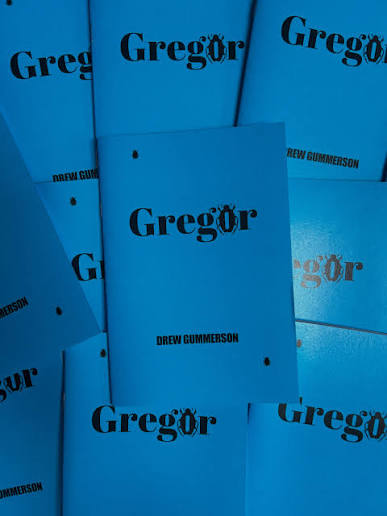
His new chapbook, Gregor, pushes that instinct into anarchic territory. It began as part of a series of stories named after men and as an experiment inspired by writers including Richard Brautigan, Arthur Bradford, Daniil Kharms, George Saunders and Donald Barthelme. Each time he finished one of their stories, he wanted to try something in its spirit.
Eventually he arrived at Kafka’s Metamorphosis, perhaps the most famous transformation in short fiction. Gummerson had never read it, so he listened to the audiobook and then reversed its premise. His Gregor remains human; it is his parents who become bugs. The resulting story follows the contours of Kafka while looking at them from a cheerfully warped angle.
Its calmly delivered grotesquery brings to mind the darker mischief of Roald Dahl: the opening of James and the Giant Peach, perhaps, in which James’s orphanhood is explained by the fatal intervention of an escaped rhinoceros. Gummerson recognises the kinship. “That’s exactly the kind of detail you’ll find in one of my stories.” If Gregor carries echoes of Rik Mayall reading George’s Marvellous Medicine on Jackanory, it is not hard to imagine it becoming a riotous story time for adults.
On the page, that speed and wildness can look spontaneous. In reality, it is carefully controlled. Gummerson begins without knowing precisely where he is going and writes until he finds an ending. Writer’s block is not much of a problem. Excess is. The first draft may be manic, or little more than lists and bullet points. Then the patient work begins.
“Sometimes, in the first flush of it, you think something is funny. You look back and think: I don’t know why I thought that was funny.” A story may arrive quickly, but he can spend weeks editing it, leave it alone, then return for several weeks more. Distance is part of the process. With no publisher waiting impatiently for the next manuscript, he can put a finished piece away for six months or a year and encounter it later with a colder eye.
He is also spectacularly ruthless. His forthcoming novella, Kuper’s Tube, began as a novel of 130,000 words. Gummerson cut almost 100,000 words from it.
The surviving story is set in a seaside town and follows Kuper, whose name nods to Peter Kuper, the cartoonist known for his work on Spy vs Spy. Kuper runs a video postcard shop. Customers stand before a green screen, record themselves against a chosen backdrop and send the clip in place of the postcards nobody buys any more. The town is sustained by migrant workers in its amusement arcades, theme park and cockle picking industry. As hostility towards migrants intensifies, it is walled off from the rest of the country. Kuper loves Antonio, who wants to escape and return to his pregnant girlfriend on the other side. Kuper wants him to stay.
The discarded version contained a serial killer, a kidnapping and a sequence inspired by *One Thousand and One Nights*, in which a captive told stories to remain alive. Once Gummerson decided those 100,000 words were not needed, he deleted them. Not archived, not transferred to a folder marked “perhaps”: deleted.
“I’m much more interested in moving forward and writing the next thing,” he says. This approach has occasionally backfired. When he wanted to include an older story in a new collection, he discovered he no longer possessed it and had to photograph every page of the published version, then extract the words with his phone.
If the editing is disciplined, the characters are allowed to be messy. Gregor is lazy, selfish and resourceful, but also capable of care. Gummerson does not build his people according to a ledger of virtues and defects, nor does he insist that they become better by the final page. “I don’t really believe in redemption arcs,” he says. Life carries on after the apparent ending. People fall out of love, become bored and regress. He describes *Flamingo Hotel* not as rags to riches but as “a story of rags to rags, doom and debauchery”.
Yet his view is less bleak than it sounds. Fiction, for Gummerson, is an exercise in empathy precisely because it places us inside the mind of somebody we might not approve of. Two people on opposite sides of a protest may appear irreconcilable, but enter their thoughts and their similarities emerge. “We don’t have to like everything about someone to think they’re an OK person, or just someone trying to get by.”
That feels particularly important in an online culture eager to reduce a person to one opinion and then condemn or block them for it. “None of us can be reduced to a single issue,” he says. His fiction makes room for contradiction: bad behaviour without monstrosity, tenderness without sainthood.
Gummerson once found himself published as an erotic writer almost by accident. An editor of the Best Gay Erotica series approached him after The Lodger and asked whether he had any stories. Gummerson sent work that seemed to him no different from his usual fiction, and it was accepted. Later, he found an American writer citing him as an early encounter with erotic fiction. “I thought: that’s not even what I do. I never found them erotic myself.”
His interest is not sex as a market category so much as desire in its broader, stranger forms: longing, jealousy, dependency, boredom and infatuation. Those ideas animate another completed but unpublished project, a collection of 20 stories based on 20 Tom Cruise films. Ten brief pieces follow two American teenage boys as they come out and fall in love. The other ten explore different varieties of love in shifting forms, including first person, second person, diary entries and notes.
In his version of Mission: Impossible, a Czech waiter in Prague after the fall of communism is infatuated with his boss while she is infatuated with capitalism. In Collateral, Cruise gets into a taxi, behaves impeccably, leaves a generous tip and exits; the passenger who follows him, a Bolivian hairdresser, turns out to be the killer. The whole collection is also a love letter to the adventurous independent fiction Gummerson admires.
He has sent it to only one publisher. Rejection no longer has the power it once did, partly because he submits sparingly and partly because he has arrived at what he calls “a Zen place” with writing. He returns often to the image of himself at 15, living above his parents’ pub. That boy would be astonished by the books, radio appearances and competition wins ahead of him.
“You can always move the goalposts,” he says. “I don’t sell as many books as Agatha Christie. I’m not widely known. I haven’t been made into films or translated. There are so many things you can feel a failure about. But now I think it’s amazing what I’ve achieved. I should be proud of myself.” If he never publishes another book, he has already proved what he needed to prove, to himself at least.
This does not mean writing is casual. Gummerson calls it a hobby because he makes his living in an office and feels embarrassed describing himself as a writer when the work earns so little. But he writes almost every day. It keeps him sane, he says, “or insane, one of the two”.
Nor does he write with a market in mind. The imagined reader does not sit beside him in bed. Each project is a private challenge. Can he build an entire world around a hotel dishwasher? Can he write 20 variations on Tom Cruise? Can he create a queer Saltburn whose stories celebrate love, difference and diversity? He is not competing with other writers, only with himself, worrying at each piece until it is as good as he can make it.
Gregor found its publisher with unusual speed. Andy Leach, founder of Sunburnt Saints, announced that he was looking for work of about 5,300 words. Gummerson had just finished a story of exactly that length. He sent it from Scarborough and received an enthusiastic response within the hour. It will become the press’s first quarterly subscription chapbook: a limited physical edition designed to be collected, slipped into a pocket and read on a train or bus.

The format has particular charm for Gummerson, a longtime admirer of chapbooks and of writers, including Charles Bukowski, whose early work appeared in them. It also revives a more innocent postal pleasure. As a child, he belonged to the Puffin Club, waiting excitedly for the Puffin Post, circling the books he wanted, sending away £1.75 and allowing the stipulated 28 days for delivery. In an age of parcels arriving on the day they are ordered, there is something luxurious about a small book appearing through the letterbox.
And after Gregor? There is Kuper’s Tube, if circumstances allow, and the Tom Cruise collection waiting patiently in the metaphorical drawer. Gummerson has already begun A Day in the Life of a Snooker Player. After that comes a book inspired by the 1980s computer game Jet Set Willy. He jokes that the rest of his writing life is already mapped out.
For now, he would like readers to finish Gregor having enjoyed its bugs, bad behaviour and reversals, and then, naturally, to buy his other books. More seriously, he hopes they will support Sunburnt Saints and the fragile ecosystem of tiny presses powered by individual enthusiasm, unpaid hours and stubborn faith.
What would Kafka make of it all? Gummerson suspects he would appreciate the humour and envy the freedom to swear. He might object to the theft at its centre, though: “He’d probably say, ‘Hands off the bugs. They’re mine.’”
Leave a Reply