
Heide Goody and Iain Grant on Creating Beck Lewis
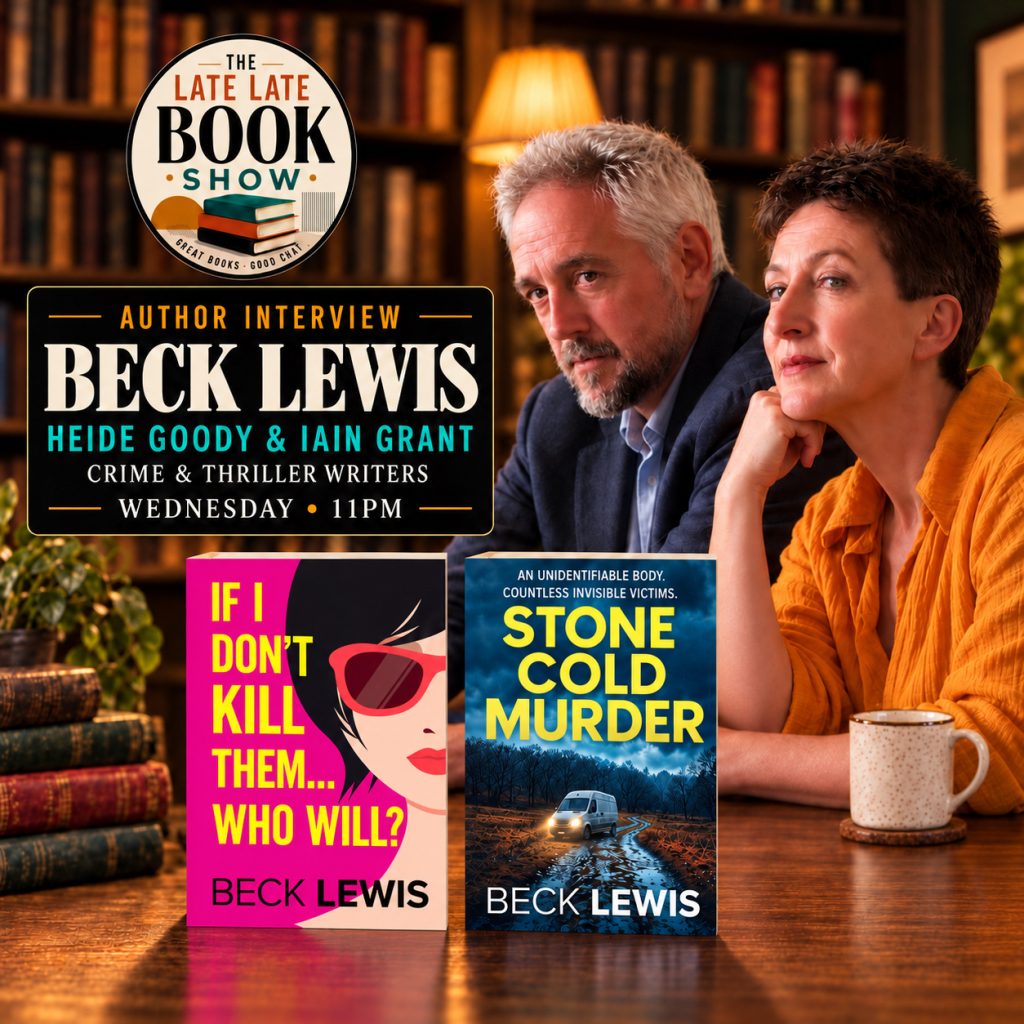
The independently published Midlands duo have produced more than 50 books together. Now operating as what they cheerfully accept is a “crime writing factory”, they talk about creative conflict, weaponised spreadsheets and inventing Beck Lewis, the imaginary author through whom they explore a broken world.
When Heide Goody and Iain Grant first considered writing together, the signs were not especially promising. They belonged to Birmingham Writers’ Group, where a workshop leader concluded a session on collaboration by asking who might like to try it. In a room full of writers, only two hands went up.
Even then, Goody waited a week before approaching Grant. “I thought, what if he says no?” she says. “The fear of rejection is strong in writers.”
He said yes. Fifteen years and more than 50 books later, the experiment has become a shared career encompassing comic fantasy, supernatural adventure, cosy mysteries, crime capers and psychological thrillers. Their characters include Satan, government employees preparing for an apocalypse and amateur detectives working in a sewing shop. More recently, the pair have created another character of sorts: Beck Lewis, the invented author under whose name they publish their darkest crime fiction.
Grant says Goody brought “a huge sense of play” to the partnership. Writing alone, he explains, can mean sitting at a keyboard wondering whether the work is rubbish or an act of self delusion. A collaborator supplies both encouragement and resistance: somebody with whom to enter an imaginary world, but also somebody willing to ask what might happen if the story were pushed further.
“Heide is very much an opener up of ideas,” he says. “What if this? What if this? She is always finding some new, extra thing, a way to push it.”
Their durability is partly explained by an unusually generous conviction. “Each of us thinks the other person does most of the work,” Grant says. It is a neat answer, but not the whole one. Early in their career, they would tell interviewers that the collaboration succeeded simply because they were nice people who got along. Time complicated that account. They have disagreed, disliked one another’s decisions and experienced the inevitable rises and falls of working in close creative proximity.
“We have lived in each other’s pockets for 15 years,” Goody says, quickly clarifying that they are both married to other people. “There have been ups and downs, but we are both pretty good communicators. When we find something we disagree about, we normally find a way to resolve it or work through it.” Some disagreements, she says, have produced “really positive and interesting sparks of possibility”.
Their first novel, Clovenhoof, took almost a year to write. In it, Satan is made redundant as lord of Hell and sent to live in suburban Birmingham. When the manuscript was finished, Goody was surprised by her sense of loss. “I felt bereft,” she says. “I thought, well, that’s gone from my life. Where’s all the fun now?”
Sales encouraged them to write another book and then another. By 2014 or 2015, Goody says, it felt as though they had discovered “a machine that’s working”. The image is apt. Their independently published partnership has since developed processes capable of producing fiction at a rate that would alarm many solo novelists. Asked to count their output over the past two years, they arrive at competing totals of 14 and 15 books. “It’s a lot,” Goody concludes, applying the sort of editorial discipline that becomes necessary when even the authors cannot immediately count the products leaving the factory. Some of those books had, they admit, been written and stockpiled earlier.
The machinery did not arrive fully formed. For Clovenhoof, they used what they call a leapfrog method. Together they established what should happen in each chapter. One wrote a detailed synopsis, the other turned it into prose, and the chapter returned to the first for editing. They worked on two chapters simultaneously, ensuring that both writers touched the whole book and smoothing their separate prose into a common voice.
Today, they exchange larger portions of a manuscript, often working on two books at once. One may spend a fortnight advancing one novel before handing it over and moving to the other. They aim for about 7,000 words each per week. On a 70,000 word crime novel, that theoretically produces a draft in five weeks, although Grant is careful to add the thinking, disagreement and editing that surround it. From beginning the prose to possessing a finished, externally edited book usually takes three or four months.
Their individual habits remain markedly different. Grant writes every morning, seven days a week, usually beginning before six. Unable to concentrate at home, he blames the television and fridge, so he takes his laptop to whichever café or McDonald’s is open, has wifi and will sell him a drink. A good session produces between 1,500 and 2,000 words. God help him, he says, if he ever moves to the countryside.
Goody also prefers mornings but writes in timed, hour long sprints, often accompanied by music an app promises will make her productive. “I’m very suggestible,” she says. “If a thing says, ‘I’m going to make you productive,’ I believe it.” Depending on the research required, she may write between 800 and 1,200 words in an hour.
Their temperaments are as complementary as their routines. Goody likes to move forwards, leaving herself notes about problems to repair later. Grant is a persistent tinkerer, researching and revising as he writes. They call his structural rearrangements “moving the furniture”. As Goody presses ahead and paints the ceiling, Grant jokes, he attends to the manuscript’s feng shui.
Technology allows them to work separately while remaining continuously aware of one another. Their shared Dropbox contains hundreds of documents, and perhaps thousands of spreadsheets. This is despite Goody insisting at the start of the partnership that spreadsheets had no place in creative work. She has not become a convert, she says firmly. The evidence is merely stored across several thousand cells. A sprawling file called the “what I’m doing document” serves as a permanent conversation: dated notes, questions and reports of progress accumulating over years.
The system is highly motivating and sometimes exhausting. Each can see the other working and consequently feels compelled to catch up. When overwhelmed, they have learned to say so. In theory, they could stop for a week and everything would remain fine; in practice, both find switching off difficult. When one travels, they institute what Grant calls “uplifting days”, during which messages in the shared document should be encouraging and nobody is allowed to begin an argument.
The process has occasionally become more intimate. When developing If I Don’t Kill Them, Who Will?, their darkly comic female revenge thriller, they wanted to find the right first person voice for Nicole Varkonyi. Borrowing from “extreme programming”, in which one programmer types as another scrutinises every decision, they hired an office and wrote side by side for four days. One worked at the keyboard while the other demanded: what are you doing, why are you doing it and why not do this instead?
“For anyone who has tried writing, imagine someone being a backseat driver,” Grant says. “It was the worst week of my life.” The outcome, however, was 5,000 words that established the voice and character of the entire novel. They loved the book that grew from them.
By then, Goody and Grant were experienced not only at sharing an authorial voice but at constructing new ones. As Millie Ravensworth, they write cosy mysteries, including stories set around a Suffolk sewing shop. Beck Lewis was created for British psychological thrillers and police procedurals: books grittier than their established comic work and very different from the cosies.
The decision was creative, but also commercial. Online bookselling systems prefer authors whose work fits recognisable categories. Goody says years of writing whatever interested them confused Amazon’s recommendation algorithm: “It takes one look at us and goes, ‘What even are you?’” Separate names protect readers’ expectations and help each kind of book reach its likely audience.
Finding Beck required research and, inevitably, a spreadsheet. They studied the names of successful contemporary crime writers and identified a fondness for short, percussive constructions: initials, hard consonants and surnames suggestive of landscape. Grant cites names such as Simon McCleave, MW Craven, LJ Ross and JD Kirk. The pair built lists of possibilities, including March, Moor and Shore, before settling on a name containing only three syllables.
“Beck” is itself a geographical feature, while Beck and Lewis could theoretically be two first names, allowing the authors to appear separately if they wished. None of this, Grant concedes, has any bearing on the quality of a book. But the result sounded like somebody who ought to write crime.
Beck soon acquired more than a name. During a day selling books at Birmingham’s Highbury Hall, Goody and Grant discussed the personality that would speak through newsletters, social media and promotional films. Goody thinks of Beck as a woman. Readers sometimes imagine a man. In either case, the voice is a version of both writers, less overtly comic than their usual public identity but unable to prevent humour leaking through.
That humour matters. The Beck Lewis books explore serious crimes and damaged lives, but Goody and Grant reject the idea that darkness demands solemnity. Human beings make one another laugh, Grant says, so fictional characters should do the same. The goal is to invite readers into disturbing territory while keeping them entertained.
The Dead Ends novels follow a Leicester police unit nicknamed the Dead End Duncans. Its detectives have been pushed away from the main team because they are unpopular with their superiors, leaving them to investigate apparently unpromising cases. Each book combines the recurring officers with a new civilian protagonist at the centre of a psychological thriller.
Goody and Grant deliberately avoided another familiar convention of police fiction. Their detectives like and support one another. There is no obligatory maverick alcoholic manufacturing conflict inside the station. Enough trouble arrives from elsewhere. The arrangement also solves a structural problem Grant finds intriguing: police officers are authority figures, while readers instinctively favour an underdog. Institutional rejection allows the detectives to be both.
The Dominion House series moves to Worcester, following an understaffed major crimes team. Its central detective, Ash Rigney, was raised in a cult and consequently views reality from an unusual angle. The opening novel, Stone Cold Murder, begins when a woman whose hands have been removed is found buried in Hagley Woods. Beneath the procedural plots, Grant sees an opportunity to examine the vast, complicated systems holding society together, systems that often seem close to collapse.
Crime, he says, provides a lens through which writers can consider surveillance, artificial intelligence, social division and the machinery of government. Fiction should not lecture its audience, but it can invite readers into an aspect of society they may rarely consider and begin peeling back its layers.
That instinct is especially visible in If I Don’t Kill Them, Who Will?, which sends an underestimated woman on a campaign of revenge against powerful men and those protecting them. Goody became fascinated by the emerging “female rage” genre through books and television series such as Sweetpea, Bella Mackie’s How to Kill Your Family and the novels of Katy Brent. She recognised an irresistible narrative engine: an angry woman with legitimate reasons to act and a list of people awaiting justice.
The story is concerned not only with obvious perpetrators but with passive accomplices. “Passivity is its own special kind of crime,” Goody says. “People who look away when a bad thing is happening, you can’t ignore that.”
Nicole receives help from her 80 year old grandmother, a former spy with an impressive collection of weapons. “Who doesn’t love a kick ass granny?” Goody asks. The character reflects a fondness running through their work for allowing older people to be disobedient. Elderly women in fiction are too often present merely to occupy a corner and behave politely. Their grandmother has agency, rage and, as Grant puts it, “a garage full of bazookas”.
Humour within such material requires a clear moral direction. Goody says their comedy always attempts to punch upwards. The people harmed by violence are treated seriously; the jokes expose those with power. Grant argues that politeness can itself become a form of evasion. A culture reluctant to discuss sexual violence or the treatment of women because the subjects are unseemly risks ignoring real experiences. Stories can approach them without diminishing victims or turning suffering into sensation.
Research helps anchor that moral and tonal balance. While writing a Millie Ravensworth mystery with Rachel McLean, the pair contacted the Metropolitan police to ask what happens when a body falls into the Thames. A sceptical marine policing inspector invited them to the unit’s Wapping headquarters. They learned about its difficult, largely unsung work and were taken out on a police boat, which suddenly received an emergency call.
The craft excursion became a high speed journey past parliament and the London Eye, only to end with officers checking on a small dog seen loose on a barge. The animal lived there and was perfectly content. It was, Goody observes, an ideal cosy mystery: apparent danger, excitement and a cheerful ending. They had missed out on a body but acquired a much nicer conclusion.
They have since discovered that security guards and other employees respond enthusiastically when visiting writers ask where they would conceal a corpse. People rarely recoil. The question is simply more interesting than being asked for the toilets.
Writing, however, now occupies only about a third of their working time. The remainder goes on the business of independent publishing, administration and promotion, particularly Facebook advertising and short form videos. Series are central to the model: an advertisement for the first of four books can become profitable if enough readers continue through the set. The easiest work to advertise is not necessarily the best, Goody says, but the one whose promise is immediately legible. A cosy mystery in a sewing shop passes what she calls the test of “semantic obviousness”. So does a brightly covered, darkly comic revenge novel about an underestimated woman. Their Skegness crime capers, inspired by wild Florida novels, are harder to explain. “Not everybody immediately gets, ‘Oh, you’re writing a Florida whack job novel set in Skegness. Of course you are.’”
They try to turn promotion into another creative outlet. A short Beck Lewis story called Man or Bear, inspired by the online question about whether a woman alone in a forest would rather encounter a man or a bear, is being made into a film. They are working with filmmakers and plan to take the result to festivals, although Grant doubts it will sell many books. They are doing it because it is fun.
That appetite creates its own difficulty. They are not going to run out of ideas; they may run out of time. A draft television adaptation of If I Don’t Kill Them, Who Will? may already be hiding on a hard drive. More Dead Ends and Dominion House novels are in progress. Every possibility must be weighed against the work that pays the mortgage and the responsibility they feel towards existing readers.
At the end of the conversation, each is asked to explain what the other contributes to Beck Lewis. Goody says Grant is much kinder to their female characters than she is, treating them with a warmth readers might not expect. Perhaps, it is suggested, he does not see the darkness inside them. Grant has a wife and daughter, someone adds. “That’s not going on a T shirt,” he replies. “I have a daughter and a wife.”
Grant says any particularly visceral or disgusting episode is likely to have originated with Goody. A plot involving detectives searching chemical toilets for financial evidence is firmly hers. The partnership’s division of labour is therefore clear. He extends warmth towards humanity; she sends the detectives into the toilets.
Finally, they are invited to complete the same sentence. “Beck Lewis is a writer we created because …”
Goody answers first: “We wanted to tell stories about the broken world that we live in, but with humour and gritty crime.”
Grant’s answer arrives at much the same destination by a slightly different route: “We wanted to explore different kinds of stories about our society, and the way that humans are messed up and the way they go wrong. And it’s been just great fun for us.”
There, perhaps, is the secret of the partnership. Their methods differ, their instincts pull against one another and even their final sentences are assembled differently. Yet both are writing towards the same place. Beck Lewis is neither Heide Goody nor Iain Grant, but the figure created in the energetic space between them.
The first Dominion House Book, Stone Cold Murder is released on 30th September. with the second, Bitter Dead Men release date later in 2026, If I Don’t Kill Them, Who Will? Is out now in all good bookshops.
Leave a Reply