

No Wands, Plenty of Dragons
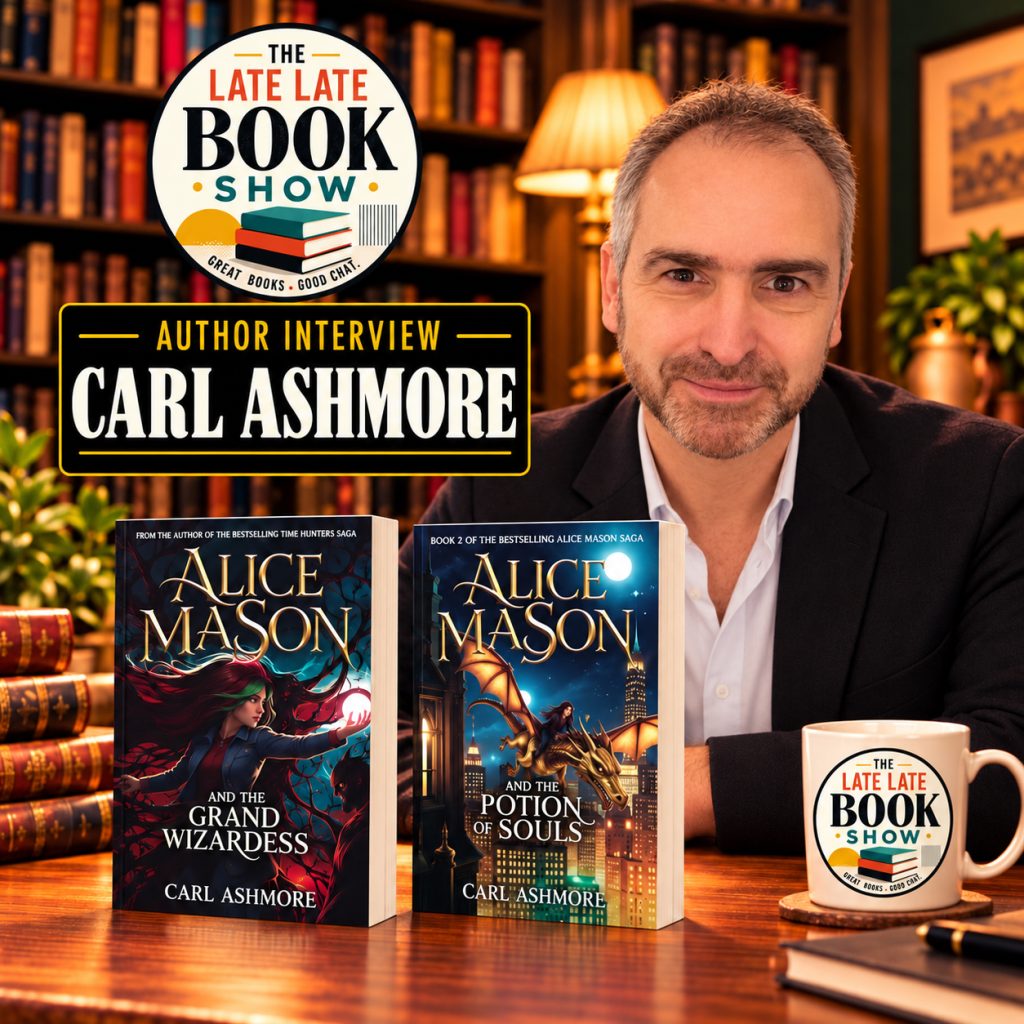
Carl Ashmore’s Magical World Takes Flight
Carl Ashmore has been inventing stories for almost as long as he can remember. His first attempt, written at the age of 10, involved a group of sharks terrorising the coast of Llandudno. Why settle for one shark, he reasoned, when you could have an entire “university” of them?
The manuscript did not survive, but the instinct behind it did: take something exciting, make it bigger and send it hurtling into an unexpected corner of the world.
Speaking to The Late Late Book Show, Ashmore is warm, candid and cheerfully self-deprecating about the long road from an imaginative boy in Crewe to a full-time bestselling fantasy author. His books may now have collected more than 9,000 reviews and found readers around the world, but his ambitions were not always met with such enthusiasm.
At a school careers interview in 1984, the teenage Ashmore announced that he wanted to become a writer. The adviser asked what his father did. When Ashmore replied that he was a postman, the answer was brutally simple: “Go away and do that.”
Instead, Ashmore studied film and media production at Bournemouth, worked in television and eventually spent 24 years teaching media. Film remained a defining influence. He talks affectionately about The Spy Who Loved Me, Raiders of the Lost Ark, Back to the Future and the Marvel comics he loved as a child. Their blend of adventure, invention and spectacle would later help shape his own fiction.
That cinematic energy is particularly evident in The Time Hunters, the 10-book series that established his career. The books combine time travel, history, mythology and breathless adventure, sending young characters into encounters with dinosaurs, pirates, legendary creatures and figures from the past. Blackbeard’s treasure chest becomes Pandora’s box, while its opening produces not only zombie pirates but zombie sharks too. The 10-year-old author of that lost Llandudno epic would surely approve.
Ashmore began writing the first Time Hunters novel during a sabbatical in south-west France. He completed an entire draft, decided it was terrible and threw it away. Then he wrote it again.
The book was eventually independently published in 2010, five years after he first began working on it. By then, he had already written three books. It is a useful reminder of how misleading the idea of an “overnight success” can be. Behind the publication date sit years of discarded pages, rejected submissions and quiet persistence.
That persistence has paid off. Ashmore has sold more than 100,000 books, secured publishing deals in several countries and built an audience that stretches far beyond the children’s market. He describes himself as a hybrid author, combining independent publishing with overseas publishing arrangements.
More importantly, his stories have become part of his readers’ lives. Children have written to tell him that The Time Hunters inspired them to begin stories of their own. One woman contacted him to explain that she had read the books aloud to her blind mother, who was in her 90s. Together, they laughed and cried over the adventures.
Ashmore says that he never really set out to write exclusively for children. He writes “for the child in all of us”, creating stories for readers who want to recover a sense of wonder.
That philosophy is at the heart of his latest series, beginning with Alice Mason and the Grand Wizardess and continuing with Alice Mason and the Potion of Souls.
The Alice Mason stories occupy recognisable Harry Potter territory: a hidden magical community, a young person discovering an extraordinary heritage and a school populated by children who do not quite belong elsewhere. But Ashmore is determined to build a world with rules, mythology and a personality of its own.
At its centre is a strong female protagonist. Alice is not waiting to be rescued or invited politely into somebody else’s adventure. She discovers that she is descended from Morgan le Fay and is thrown into a conflict involving ancient magic, Arthurian legend and a descendant of Merlin, who in Ashmore’s version of the story was not a kindly mentor but one of history’s most dangerous magical figures.
There are no wands. Magic operates according to its own system, and Ashmore’s hidden world is spread across phantom towns, mysterious districts and islands that have vanished from conventional maps. His inspiration comes as much from British folklore and historical mythology as from modern fantasy.
And there are dragons. Lots of dragons.
After deliberately avoiding them throughout the 10 Time Hunters books, Ashmore has made up for lost time. The Alice Mason world contains titan dragons, racing dragons, earth dragons and fire dragons. Some are small enough to resemble dachshunds; others are enormous fighting beasts. Not all of them breathe fire, although the smaller ones might still prove useful when the candles need lighting.
In The Potion of Souls, Alice travels to New York, where one of the novel’s great set pieces is a dragon race across the city. Riders must collect ribbons from landmarks including the Chrysler Building, the Empire State Building, One World Trade Center and the Statue of Liberty before racing back to the Grand Arcanium, a vast magical shop.
Ashmore describes dragon running as his world’s answer to Quidditch, but the image also reflects his background in film. He writes visually, constructing scenes that feel ready to burst onto a cinema screen.
The origins of Alice Mason are more intimate. Ashmore’s daughter, Alice, was six when he promised to write a magical adventure named after her. She loved the Harry Potter films and dressed as Hermione, and the two of them spent long walks discussing villains, magical rules and the sort of world they wanted to create.
The book took years to arrive because Ashmore felt he had to complete The Time Hunters first. By the time the first Alice Mason adventure was published, his daughter was 16. The delay, however, gave the imagined world time to deepen.
Those early conversations between father and daughter remain embedded in the books. Ashmore wanted Alice to grow up with a story carrying her name, and that emotional foundation gives the series a warmth beneath all its monsters, mysteries and aerial dragon races.
His writing process is both instinctive and painstaking. He dislikes facing the blank page but loves editing. A first draft, he says, is like throwing a lump of clay onto a wheel; the pleasure comes from gradually shaping it into something coherent and evocative.
He works chapter by chapter, repeatedly revising each one before moving on. He even formats chapters for his Kindle and reads them in a Nantwich coffee shop, noting errors on his phone before returning home to make corrections. A novel may take around 10 months, followed by further revisions and a professional edit.
Ashmore is refreshingly honest about the demands placed on independent authors. Writing the book is only part of the job. There is marketing, design, social media, advertising and audiobook production to consider. His own working day can begin before dawn, with promotional videos edited in the bath before the household wakes and the school run begins.
Yet he remains deeply committed to human creativity. His Alice Mason books are illustrated by Lex Goodwin, while editor Kath Middleton and audiobook producer Lee Beddow form part of the small creative team surrounding his work.
For aspiring writers, Ashmore’s advice is encouraging but unsentimental. Make the book as good as it can be. Learn about the practical side of publishing while you write. Find skilled people whose work you trust. Above all, do not begin until you feel that the story genuinely needs to exist and that you are the person who must tell it.
It is advice drawn from experience. Ashmore ignored the careers adviser who tried to narrow his future, rewrote the novel that initially failed and kept working until his imagined worlds found an audience.
The result is fantasy in the broad, generous tradition of Harry Potter, but with a formidable girl at its heart, a magical system without wands and enough dragons to fill the skies over New York. More than anything, these are stories designed to offer escape: a way for children and adults alike to step through an unseen doorway and rediscover the exhilarating feeling that another world might be waiting just out of sight.
Leave a Reply