

‘Bookselling is the job I didn’t know I wanted’
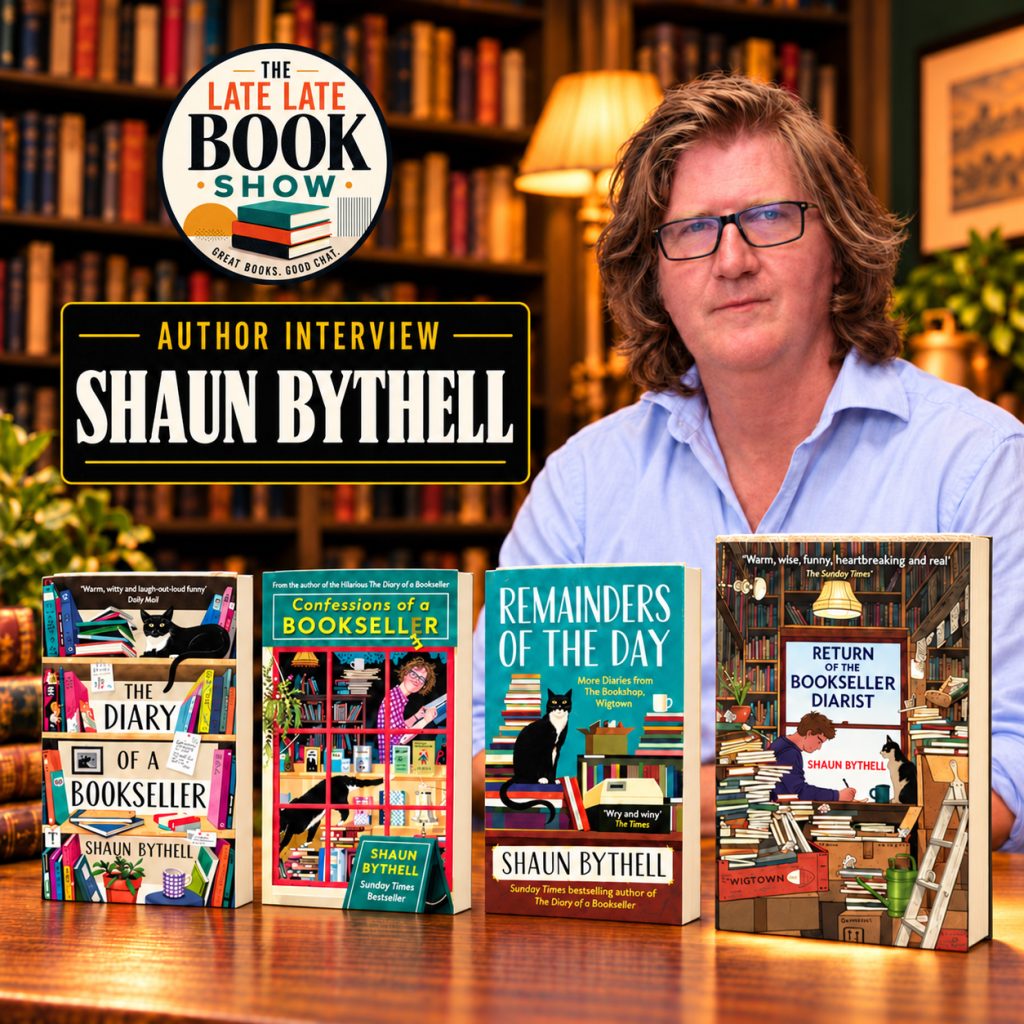
The owner of Scotland’s largest secondhand bookshop talks to The Late Late Book Show about accidental careers, eccentric customers, dead rats and his new book, Return of the Bookseller Diarist.
Shaun Bythell’s life as a bookseller feels like a cross between Adrian Mole, Lovejoy and The Vicar of Dibley. There is the dry, self questioning wit of Mole, the thrill of discovering overlooked treasures familiar from Lovejoy, and the unmistakable warmth and eccentricity of a tightly knit rural community.
At the centre of it all is The Bookshop in Wigtown, Scotland’s National Book Town. It is the country’s largest secondhand bookshop, containing around 100,000 books spread across almost a mile of shelving. Bythell has owned it for 25 years, living above the shop in a grand Georgian building that was once the home of the town provost.
Speaking to The Late Late Book Show from Wigtown, he is surrounded by the raw material of his writing: books, customers, colleagues, neighbours and the small daily incidents from which his bestselling diaries are made.
His latest volume, Return of the Bookseller Diarist, returns to this world after a four year absence. It is the fourth instalment in the diary series, following The Diary of a Bookseller, Confessions of a Bookseller and Remainders of the Day. Published in October 2026, the new book follows Bythell as he shifts from rural bookseller to nervous published author, taking the story up to the first day of the pandemic.
Yet bookselling was never part of a carefully constructed career plan.
Bythell studied law, then made what he calls the “foolish decision” not to follow his contemporaries into predictable professional careers. Instead, he drifted through an assortment of jobs, including work in gas pipeline construction. By the age of 30, he was temping at the University of the West of England and watching friends buy homes and start families while his own salary barely covered the rent.
During a Christmas visit to his parents, he called at their local bookshop and spoke to its owner, who was preparing to retire.
“He asked me what I was doing, and I told him,” Bythell recalls. “He said, ‘You should buy my shop.’ I thought, well, I’ve got no money and no experience. He said, ‘Don’t worry about that. Borrow the money from the bank and I’ll teach you.’”
That is more or less what happened.
“It was never a plan,” he says. “It was one of those moments when you think, here is what looks like an opportunity. It could end up not working out, but if I don’t take this chance, I’ll probably regret it forever.”
He took the chance and has never regretted it. Bookselling, he says, became “the job I didn’t know I wanted” and proved more fulfilling than any career he could have imagined.
The romantic image of running an old bookshop in a Scottish town is certainly seductive. The Bookshop has twisting rooms, open fires and shelves packed with forgotten histories, neglected novels and the occasional valuable discovery. Every day promises something unexpected.
What Bythell loves most is the “chaos within a framework”. The shop opens and closes at predictable times, but everything in between is uncertain.
One day he might drive to Ayr to collect books and somehow return with an enormous Georgian dining table he does not need. The next, he might clear a house in Dumfries without knowing anything about its owner or whether the books will be treasures or rubbish. Customers arrive carrying boxes inherited from grandparents or emptied from attics. A book requested in the morning may appear, by remarkable coincidence, in a collection brought in that afternoon.
“You just don’t know what’s going to come your way each day,” he says. “There’s always something new.”
The reality is not always as cosy as visitors imagine. Shortly before our conversation, Bythell’s home and neighbouring properties had suffered an infestation of rats. The rats had gone, but some had died beneath the floorboards, leading to an abundance of bluebottles and the installation of a noisy electric fly killer.
His young cat proved a brutally efficient assistant, catching 12 rats in three weeks. Smaller victims were eaten whole; larger ones were decapitated and left on the kitchen floor.
“It’s nonstop glamour,” Bythell says.
The infestation did, however, bring him closer to two neighbours. After exchanging late night messages about their shared torment, the three became known locally as “the rat gang”.
Such incidents capture the mixture of irritation, affection and absurdity that animates Bythell’s books. They portray his life as a bookseller without turning it into a rural fantasy. Wigtown can be charming and communal, but it is also a real place filled with leaking roofs, difficult customers, dead rodents and everyday obligations.
Bythell is wary of forcing eccentricity onto the page.
“I don’t overplay it, because overwritten quirkiness is unreadable,” he says. The people around him are funny because they are recognisably human, not because they have been turned into comic creations.
One of the best loved figures in his earlier diaries is Nicky, a former employee with a talent for skip diving and an instinctive sense of timing.
“She was my favourite employee of all time,” Bythell says. “She was one of the few people I’ve met who had natural comic timing in conversation. A pause with Nicky was always the perfect length, not a millisecond too long or too short.”
He now employs a different Nicky, whom he jokingly calls “Nicky 2.0”, alongside other part time staff. When writing about employees or customers, he tries to avoid causing harm. Events are true, but identifying details may be altered if a story feels sensitive.
“I know people probably find this hard to believe, but I don’t set out to upset anybody,” he says.
The diaries began almost accidentally. Staff and customers had long told him that someone should write a book about the strange things that happen in secondhand bookshops. Then bookseller Jen Campbell published Weird Things Customers Say in Bookshops, seemingly claiming the territory Bythell had vaguely imagined occupying.
His partner at the time suggested a different approach. Since his memory was poor, why not keep a diary? If he eventually decided to write a book, the material would already exist.
Bythell began recording events as they happened. Because he could touch type, he often captured conversations while customers were still standing in front of him. The earliest notes were skeletal: somebody dropped a book, swore, bent down or broke wind. They were observations rather than finished prose.
He sent this raw diary to a literary agent, who saw promise but told him it needed considerable polishing. That established a method he still uses. First he records the basic facts. At the end of the year, he returns to the notes and turns disconnected events into a readable narrative.
The process is more laborious than the conversational ease of the finished books suggests. A volume may pass through five rewrites before publication.
“By the end of it, I’m absolutely sick of it,” he says. “Every time I reread it, I think, God, this is rubbish. Eventually you just have to hope you’ve done your best to make it not quite as rubbish as it was.”
Without a publisher’s deadline, he suspects he would revise forever. Once a book is printed, he has little desire to read it again. On the rare occasions when he must revisit a passage, he sometimes thinks it is “not that bad”. More often, he wishes he had another chance to rewrite it.
The daily notes also show him how unreliable memory can be. Events he remembers in one order may have occurred quite differently. A friend he thought had been rude or absent might, on consulting the diary, turn out to have been in hospital after an accident.
“Your memory is incredibly unreliable,” he says, “but a diary is considerably less unreliable.”
Return of the Bookseller Diarist draws on three years of these observations and ends as the country enters lockdown. Bythell has continued writing every day, leaving him with another six years of unpublished material. Whether it becomes another book will depend on readers and his publisher.
“I don’t want to be known as the guy who kept flogging the dead horse,” he says. “Everything in each book is different from the previous one. If there’s no interest, I’ll stop publishing them, but I won’t stop gathering the material.”
Success has brought international readers to Wigtown, but it has done little to alter his standing among his neighbours. Many residents do not know he has written books; those who do are largely unimpressed.
“There’s no big fish, small pond thing in Wigtown,” he says. “We’re all the same size fish. How you conduct yourself in your daily life is far more important than whether you’ve written a book or released an album.”
After his first book became unexpectedly successful in New Zealand, Bythell appeared before a sold out audience of several hundred people at the University of Otago. On returning home, he gave a talk at a library in Dumfries. Six people attended. Three were asleep before he began and, according to Bythell, all six were asleep by the end.
“You can’t get too big for your boots here,” he says. “The plumber is definitely held in higher esteem than I am in Wigtown.”
That rootedness may explain why his diaries have travelled so well. Beneath the misanthropic jokes and complaints about customers is a portrait of someone who genuinely loves the unpredictable life he has built.
He works six days a week and sometimes seven. The shop, book buying, writing and local events consume much of his time, but he still fishes, tends his garden and occasionally goes mountain biking. Self employment demands long hours, but it does not feel like working for somebody else.
“It’s like a vocation,” he says. “I don’t feel shortchanged by it in any way. I feel completely fulfilled.”
A television or film adaptation may yet take Bythell’s world beyond the page. Discussions with a production company are under way, although he refuses to become excited until something actually happens. Asked who might play him, he admits to being too detached from popular culture to suggest anyone. The Late Late Book Show offers Hugh Grant, who already has experience behind a fictional bookshop counter in Notting Hill.
Bythell is amused by the suggestion, although he would be flattered by anyone willing to take the role.
For now, he remains where readers expect to find him: behind the counter in Wigtown, surrounded by books, mildly exasperated by humanity and alert to the next story walking through the door.
It is a life with the comic frustration of Adrian Mole, the treasure hunting possibilities of Lovejoy and the close community spirit of The Vicar of Dibley. The fantasy of bookselling and its untidy reality meet in the same building, and Bythell continues to record both with warmth, honesty and an expertly timed complaint.
Leave a Reply