

M W Craven: ‘Everything in my life seems to have happened by happy accident’
The bestselling crime writer talks about joining, and leaving, the army almost by chance, writing his way through trauma, the luck behind literary success and why Washington Poe and Tilly Bradshaw still have darker places to go.
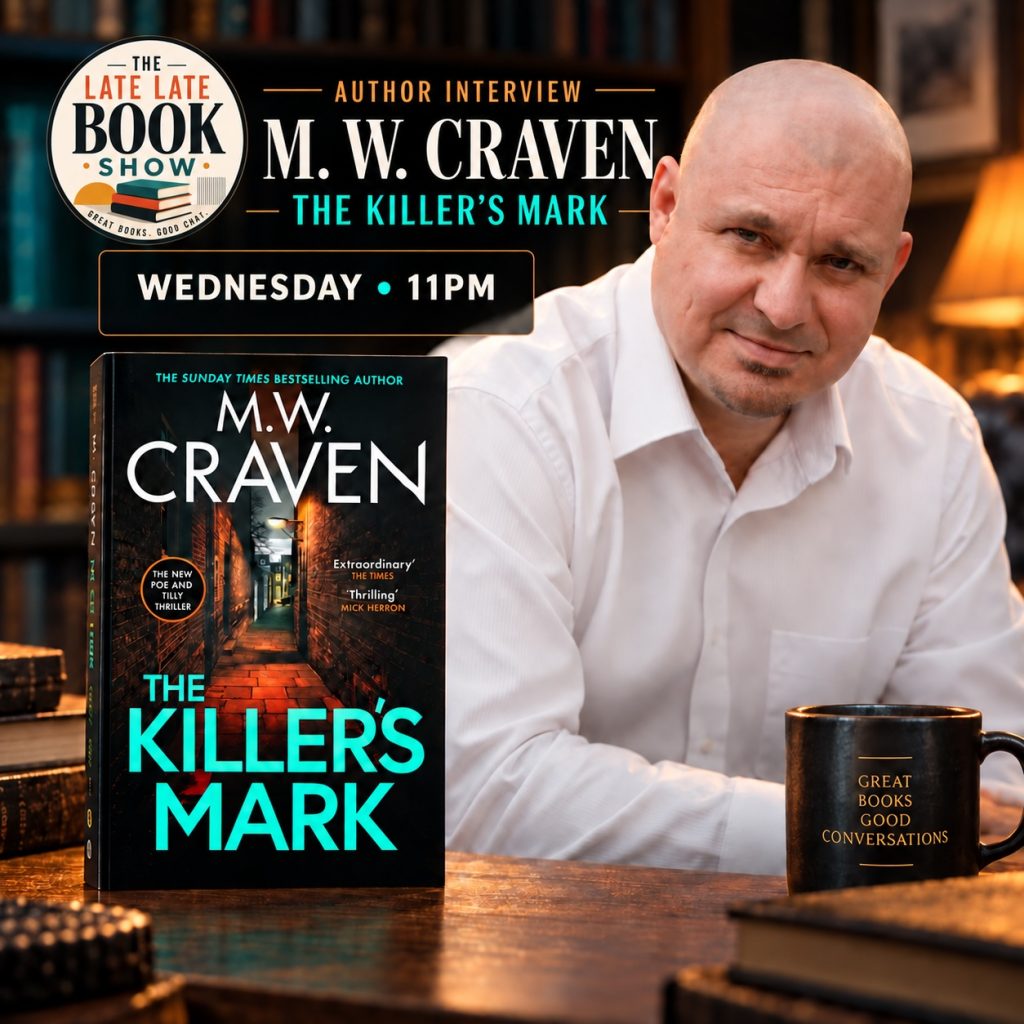
M W Craven would prefer to introduce himself without fanfare. “I’m M W Craven, but please call me Mike,” he says. “I’m an author. That’s enough, isn’t it? The rest is just tinsel.”
There is, admittedly, rather a lot of tinsel. Craven is a Sunday Times bestseller whose books have sold more than a million copies and been translated around the world. He has won both the CWA Gold Dagger and the Ian Fleming Steel Dagger, while his Washington Poe novels, with their gruesome crimes, Cumbrian landscapes and flashes of bone-dry humour, have inspired a fiercely loyal readership.
Yet the detail that momentarily wrongfoots him is not an award or a sales figure. It is the revelation that he once had a perm.
“I really liked my perm at the time,” he protests, before revising the historical record. “It was the period when my hair was naturally curly, that’s what I like to call it.”
The perm eventually gave way to a shaved head, which he has kept ever since. Fame, too, arrived gradually. Craven says he is recognised more often now, usually in encounters that are affectionate, if occasionally badly timed.
For a couple of months, readers repeatedly approached him for photographs at concerts—in the toilets. “It happened five or six times,” he says. “I’d be smiling for the camera and behind us there would be loads of men at the urinals, waving.”
Less charming was the reader who joined Craven and his wife, Joanne, uninvited at their restaurant table and began discussing the books. Most meetings, though, remain a pleasure. For someone whose career has taken so many unexpected turns, being stopped by strangers who know his fictional characters must still feel slightly improbable.
Craven grew up outside Newcastle with two sisters and parents who encouraged all three children to read. Library visits were precious because borrowers could take home only a handful of books. Craven would race through his own selection, then read his sisters’ books too.
He progressed from Enid Blyton to his father’s novels, with Alistair MacLean providing his first taste of adult fiction. He was the archetypal child reading beneath the bedclothes with a torch, continuing until he could no longer keep his eyes open. He also wrote stories and persuaded his mother to buy him a correspondence course from the Writers Bureau.
Even so, authorship did not appear to be a realistic profession. At 16, he had no clear idea what he wanted to do. A friend planned to join the army, so Craven accompanied him to the recruitment office. The recruiter suggested that, since he was already there, he might as well take the tests too.
Craven joined. His friend became a painter and decorator.
“I joined the army by accident,” he says, “and I left by accident as well.”
After almost 12 years, he went looking for a leave form and spotted somebody else’s application to leave the forces. In that instant, he decided it was time to go. The army required 12 months’ notice, a system Craven suspects was as much about retaining soldiers as preparing them for civilian life, but his decision held.
Once again, he had no plan. Walking between pubs in Newcastle one Christmas Eve, he passed the university and announced that he was going to study law. A professor told him he would first need to prove himself academically, so he went to college and completed three A-levels. When the time came to apply for his degree, however, he noticed that the social work course lasted only two years.
“So I did that,” he says. “I had no interest in social work at that point.”
His specialism was determined with similar spontaneity. While queuing to select modules, he struck up a conversation with the man in front of him, who planned to become a probation officer. By the time Craven reached the head of the queue, he had decided to become one too.
The stranger became his best friend. Craven went on to spend years in the probation service, eventually becoming an assistant chief officer.
“My life has been a series of happy accidents,” he says. “I had a very average army career and a very good probation career. Some of it was just absolute blind luck.”
The experiences accumulated during those years later gave his fiction its authority. He absorbed not only procedures and professional knowledge, but the ways people speak, behave and protect themselves. A writer, he suggests, stores away a remark made 20 years earlier without knowing when it might become useful.
The army also widened his reading. Soldiers passed novels between them in the field because books were lighter than carrying an extensive personal supply. Jack Higgins, Frederick Forsyth and other thriller writers circulated through what became, in effect, an informal book club.
“If you didn’t read, you had literally nothing to do except stare into space,” he says. “We’d all read the same books, and then we’d discuss why we liked or disliked them.”
During those years, however, he did not write a sentence. It took a devastating illness to return him to the page.
In 2003 and 2004, Craven became so unwell that doctors told him he was going to die. His mother and sisters were advised to prepare for his funeral. Then a final test offered a sliver of hope and treatment began again.
He survived, but left hospital unable to resume the life he had known. Golf, cricket and cycling were suddenly beyond him. His mood darkened. Only years later, while writing The Mercy Chair, did he recognise that he had been experiencing post-traumatic stress.
At the time, he simply picked up a pen.
“I remembered that I used to enjoy writing,” he says. “So I started again, just for myself.”
His first instinct was to describe his hospital experience directly, in the hope that setting it down would help. He quickly found the process unbearable. Instead, he began a crime novel and gave its detective the same illness and experiences. By transferring his memories to a fictional character, he created enough distance to examine them.
“It allowed me to remember things I’d forgotten,” he says. “It was therapeutic.”
That manuscript became Born in a Burial Gown, featuring the detective Avison Fluke. Its title now seems almost unnervingly appropriate.
Craven’s first 3,000 words were shortlisted for the Crime Writers’ Association’s Debut Dagger. Encouraged by an agent who asked to read the completed novel, he promised to deliver it within six months.
The resulting 150,000-word manuscript was, by his own estimation, “absolutely dreadful”. What began as a police procedural had swollen into an extravagant thriller in which Fluke fought off AK-47-wielding assassins with a church candle.
The agent declined to represent it, but gave him a detailed critique. Craven remains grateful. “She ripped it to pieces, but when you saw the problems in black and white, she was absolutely right.”
He cut the novel to roughly a third of its original length. It was published in 2015, after a chance meeting with an independent publisher at a writing workshop in Gretna. Another workshop led him to agent David Headley, who remains both a trusted adviser and friend.
A memorable encounter with Lee Child also helped shape his career. Child advised him to attempt something unlike anything he had written before, so Craven tried a first-person action thriller. That experiment eventually became Fearless.
The Washington Poe series began with The Puppet Show, the novel many readers assume transformed Craven into an overnight success. The truth is less dramatic, and perhaps more encouraging. The Puppet Show performed respectably and won the CWA Gold Dagger, but its sequel, Black Summer, initially sold fewer copies.
The breakthrough came with the third book, The Curator, published in June 2020. With lockdown forcing many publishers to postpone major releases, Craven found himself with an unusually clear run at the newspapers. The novel was widely reviewed, readers discovered the earlier books, and momentum began to build.
Since then, each instalment has outsold its predecessor. Craven refuses to pretend that talent and hard work alone explain a successful career.
“Cream doesn’t always rise to the top,” he says. “We all know incredibly talented authors who have never had the breaks, never found a publisher or never managed to get an agent. Luck plays a part in every successful career. But if you keep ploughing away, eventually you might get lucky.”
What keeps readers returning is the partnership at the heart of the series. Washington Poe is irascible, instinctive and damaged; Tilly Bradshaw is a brilliant analyst whose literal honesty and social awkwardness give the books much of their warmth. Around them, Craven constructs crimes that are often horrifying but never entirely devoid of humanity or humour.
In The Killer’s Mark, the eighth Poe novel, the pair have left the police and become private investigators, “gumshoes for hire”, according to the sign on their door. Poe is living with the consequences of PTSD and hopes for a quieter existence involving harmless lost-property cases.
Naturally, that is not what he gets.
Tilly insists they accept the next person who walks into the office. The visitor is 15-year-old Desmarie Blue, an American girl who believes she has seen her supposedly dead mother in a pornographic film. What begins as a missing-person inquiry leads Poe and Tilly into a world of exploitation, trafficking and violence.
“It’s probably the second-darkest book I’ve written,” Craven says. “Not as dark as The Mercy Chair, but it is quite nasty.”
That darkness is balanced by his affection for the characters and for the readers who have followed them across eight novels. He does not take their loyalty for granted. Meeting readers, he says, remains one of the best parts of the job, even if he might prefer that they wait until he has left the toilets.
For all the awards, sales and recognition, Craven still speaks of his career with the mild astonishment of somebody who wandered into it through a succession of open doors. The army, probation, writing: none followed a carefully engineered plan. Each began with a conversation, a form, a queue or a sudden decision.
His success may contain its share of happy accidents. What happened afterwards, the persistence, rewriting and willingness to learn, was anything but accidental.
M W Craven latest novel The Killer’s Mark is out now. In all good book shops and online.
Leave a Reply